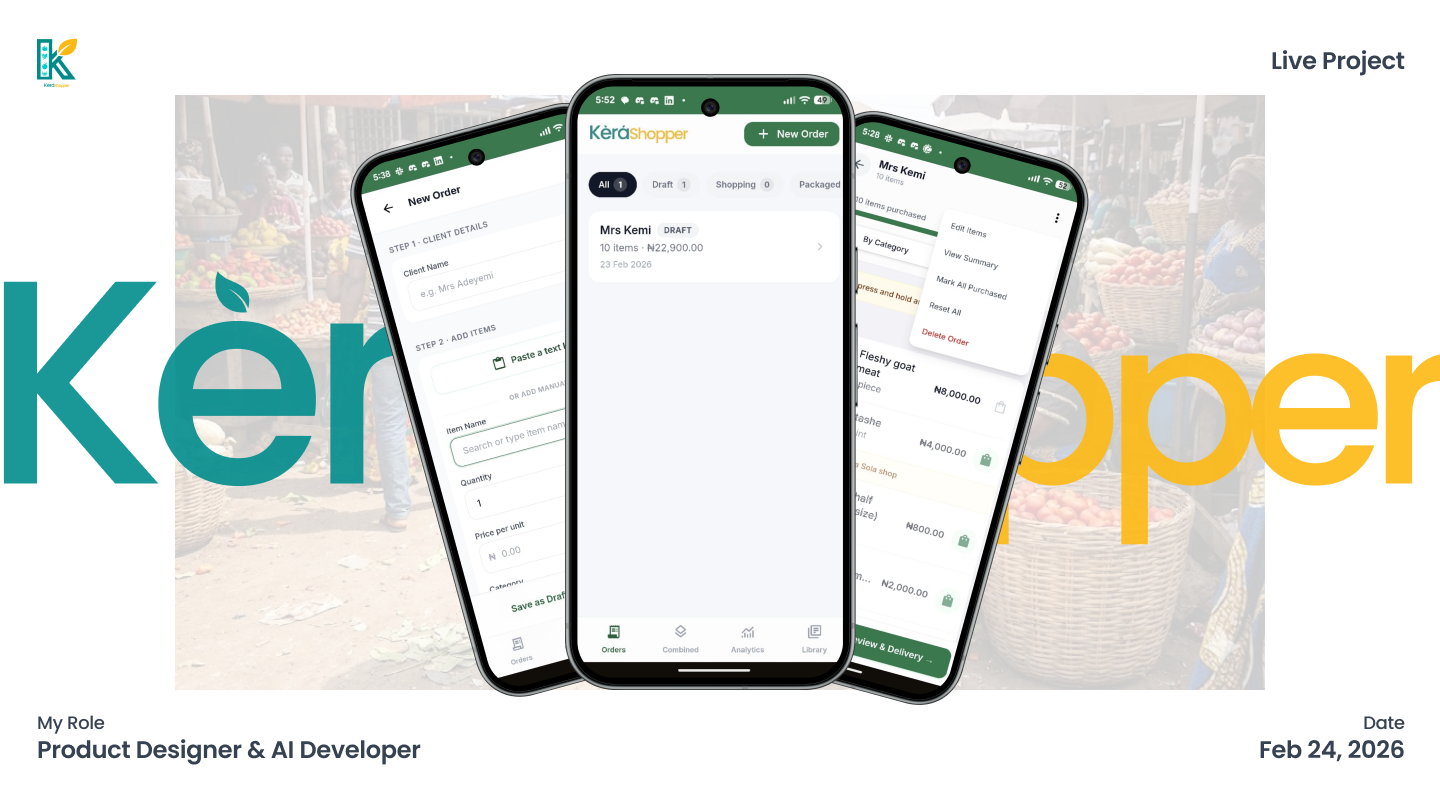
My wife runs a market errand shopping service in Lagos. She receives food item orders via WhatsApp, physically shops at a busy outdoor market, packages everything by client, and arranges delivery. Her workflow was entirely manual: paper lists, mental arithmetic, and memory-based tracking.
This led to frequent mistakes, forgotten items when shopping for multiple clients, pricing errors, and no visibility into actual profit after expenses. She needed a tool built specifically for her reality — not a generic shopping app.
- Manual list management across multiple clients
- Mental math for pricing and profit calculation
- No structured workflow from order to delivery
- Forgotten items when shopping for 3+ clients
- No way to track expenses or actual profit
- All data stored in WhatsApp chat history
- Must work offline (unreliable market connectivity)
- One-handed operation (holding shopping bags)
- Large touch targets (wearing market gloves)
- Fast load times on budget Android phone
- No app store deployment complexity
- Free hosting and infrastructure
I shadowed my wife through three full shopping days, observing her actual workflow in the market. Key insights emerged:
Paper-First Workflow
She rewrites WhatsApp lists on paper, reorganizing by memory of where items are in the market.
Mental Arithmetic
All pricing calculations done in her head while negotiating with vendors.
Spatial Memory
Shopping route is optimized by physical market layout, not item categories.
Item Staging
Purchased items stored at multiple stalls while continuing to shop.
Post-Shopping Sorting
All items sorted and packaged by client after shopping is complete.
Blind Profit
No clear view of profit until the end of the day, after all expenses.
Based on my research, I established three core design principles that guided every decision:
Offline-First Architecture
All data must work without internet. Markets don't have reliable WiFi, and her phone signal drops constantly inside covered market areas.
One-Handed Optimization
Primary actions in the bottom 40% of the screen, minimum 56px touch targets, swipe gestures for common tasks.
Dual Mental Models
Support both category-based thinking (Fruits, Vegetables) and spatial memory (market route order) for list organization.
Single Order Management
- Order entry with client name & item list
- Real-time subtotal & service charge calculation
- Expense tracking & profit estimation
- Dual sorting: by category or market route
- In-market tick-off with offline mode
- Storage notes per item (staging locations)
- Delivery details capture
Multi-Order Features
- Combine 2+ client orders into one master list
- Client name labels on each item
- Combined tick-off with progress tracking
- Separate profit calculation per client
- Template system for recurring orders
- Master catalogue of all market items
I chose a PWA over native apps to avoid app store complexity and enable instant updates. The offline-first architecture ensures reliability in low-connectivity environments.
60% Faster Prep
Order preparation reduced from 15 minutes to under 5 minutes per order.
Zero Errors
100% calculation accuracy across 30-day usage period with 50+ orders.
3x Order Capacity
Successfully handles 3 concurrent client orders with no item mix-ups.
Clear Profit View
Real-time profit visibility enables better pricing and expense decisions.
True Offline Mode
App functions fully in market with zero connectivity issues.
8/10 Ease of Use
User self-reports high satisfaction after 2 weeks of daily use.
Design for actual context, not ideal conditions. My initial designs assumed reliable internet and two-handed use. Observing real use revealed the need for offline-first and one-handed optimization.
Support multiple mental models. Users think about the same data in different ways at different times. Category sort works for order entry; route sort works in the market.
Shipping beats perfecting. I launched with 70% of planned features. The missing 30% turned out to be less important than I thought. Real usage revealed what actually mattered.
AI amplifies execution speed. Using Google Antigravity as a co-developer, I shipped production-quality code in 3 weeks as a solo builder. The AI handled implementation; I focused on product decisions.